
Special Districts 2024 Budget
What are special districts, and how are they related to Mesa County?
Numerous special districts exist in Mesa County to finance certain public services, from libraries and schools to fire stations and pest control. While most of these districts are distinct units of local government and do not receive financial support from the County, Mesa County oversees seven public improvement districts (PID) and one local improvement district (LID). Each of these districts is a separate legal entity with its own budget. District revenues and expenditures are not included in Mesa County's budget, but are presented alongside the County's budget to conform with generally accepted accounting principles. Voters have exempted most of the districts from the constitutional tax and spending limits established under the Taxpayer Bill of Rights (TABOR). The Mesa County Board of County Commissioners serves as the ex-officio board of each district, with the authority to approve budgets and levy taxes.
Upper Grand Valley Pest District
The Upper Grand Valley Pest District was formed in 1965 in order to protect commercial fruit growers on the eastern end of the Grand Valley from insect, disease, and weed infestations. Staff from Mesa County’s Noxious Weed and Pest Management Department are responsible for weed and pest control activities in the district, including responding to complaints, inspecting nursery stock, identifying and managing infestations, and educating the public. An advisory board made up of area fruit growers directs the operations of the district.
The district receives most of its revenue from property taxes. In 2024, the district will levy 0.089 mills.
Budget
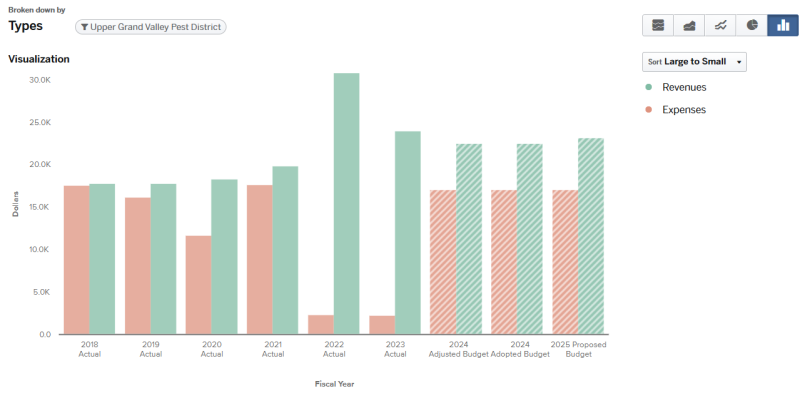
| Fiscal Year | Expenses | Revenues |
|---|---|---|
| 2018 Actual | $17,574 | $17,837 |
| 2019 Actual | $16,166 | $17,817 |
| 2020 Actual | $11,693 | $18,356 |
| 2021 Actual | $17,674 | $19,892 |
| 2022 Actual | $2,386 | $30,781 |
| 2023 Actual | $2,280 | $23,971 |
| 2024 Adjusted Budget | $17,051 | $22,513 |
| 2024 Adopted Budget | $17,051 | $22,513 |
| 2025 Proposed Budget | $17,051 | $23,221 |
Mesa Community Center PID
The Mesa Community Center PID was formed to fund the operations and maintenance of the community center in Mesa, CO. An advisory board elected by district residents works with Mesa Community Club, Inc. to manage the operations and budget of the community center. Mesa County staff assist the advisory board with capital improvements, securing grants, paying bills, collecting taxes, preparing financial statements and annual budgets, and conducting mill levy assessments.
The district receives most of its revenue from property taxes. In 2024, the district will levy 1.000 mills. The district is exempt from TABOR spending and revenue limits.
Budget
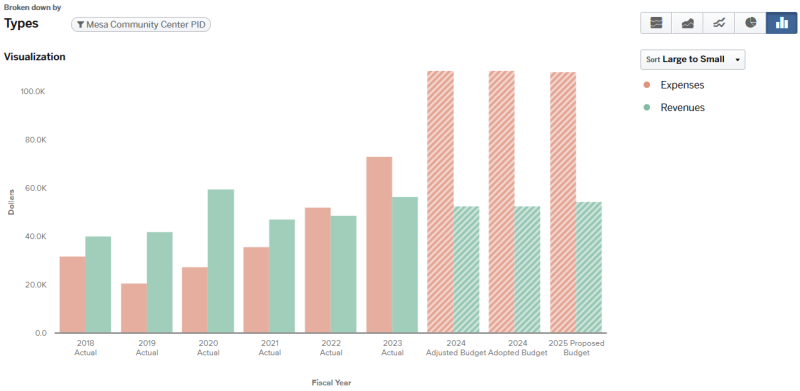
| Fiscal Year | Expenses | Revenues |
|---|---|---|
| 2018 Actual | $31,985 | $40,088 |
| 2019 Actual | $20,734 | $41,944 |
| 2020 Actual | $27,593 | $59,567 |
| 2021 Actual | $35,682 | $47,187 |
| 2022 Actual | $52,144 | $48,755 |
| 2023 Actual | $73,251 | $56,553 |
| 2024 Adjusted Budget | $108,450 | $52,689 |
| 2024 Adopted Budget | $108,450 | $52,689 |
| 2025 Proposed Budget | $108,250 | $54,359 |
Mesa County Gateway PID
The Mesa County Gateway PID, which includes both a public improvement district and a local improvement district, was established by voter approval in 2010 to provide services to residents of Gateway, CO. The district is authorized to provide services including fire protection, police, emergency medical services, road improvements, water and sewer services, and parks and recreation facilities. Revenues generated by the districts are sometimes transferred to the Southwest Mesa County Rural Services PID to support sewer improvements in Gateway.
The Gateway PID receives most of its revenue from property taxes, levied at a rate of 14.000 mills. The Gateway LID receives most of its revenue from a 0.5% sales tax. Both districts are exempt from TABOR spending and revenue limits.
Budget
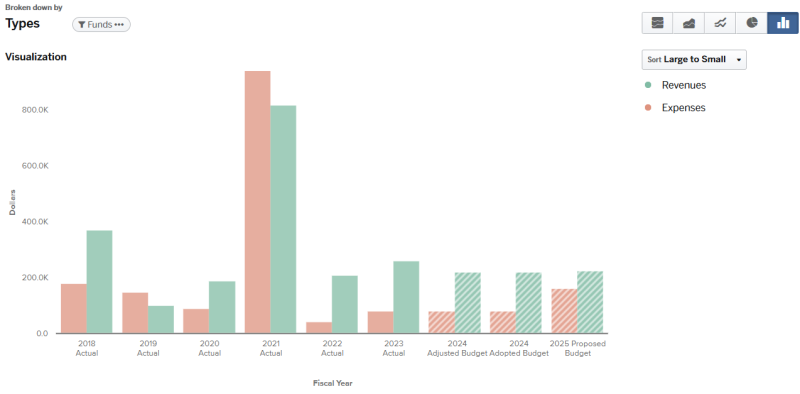
| Fiscal Year | Expenses | Revenues |
|---|---|---|
| 2018 Actual | $180,019 | $371,464 |
| 2019 Actual | $148,074 | $100,013 |
| 2020 Actual | $89,002 | $189,455 |
| 2021 Actual | $938,344 | $818,081 |
| 2022 Actual | $43,050 | $209,349 |
| 2023 Actual | $80,106 | $260,389 |
| 2024 Adjusted Budget | $80,650 | $220,800 |
| 2024 Adopted Budget | $80,650 | $220,800 |
| 2025 Proposed Budget | $162,650 | $224,853 |
Whitewater Urban Services PID
The Mesa County Whitewater Urban Services PID was established by resolution of the Board of County Commissioners in 2008 to provide services in Whitewater. Services may include fire protection, police, emergency medical services, road improvements, water and sewer services, and parks and recreation facilities. Voters approved a sales tax for the district in 2008 in order to fund services.
Most of the district’s revenue is from sales taxes, with a small portion of revenue from property taxes. In 2024, the district will levy 4.000 mills. The district is exempt from TABOR spending and revenue limits
Budget
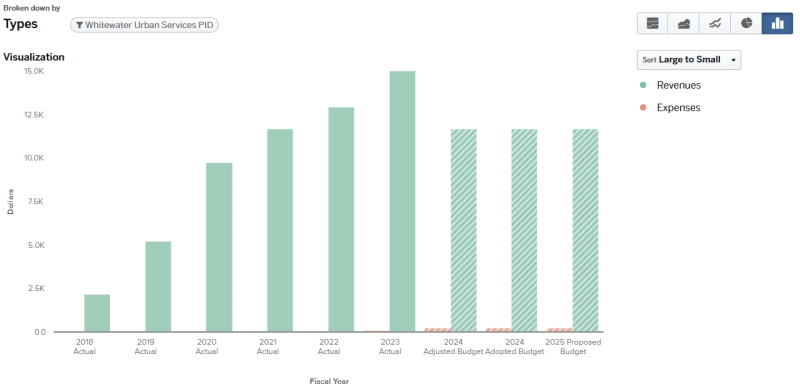
| Fiscal Year | Expenses | Revenues |
|---|---|---|
| 2018 Actual | 0 | $2,183 |
| 2019 Actual | 0 | $5,247 |
| 2020 Actual | 0 | $9,775 |
| 2021 Actual | $37 | $11,690 |
| 2022 Actual | $46 | $12,960 |
| 2023 Actual | $106 | $15,005 |
| 2024 Adjusted Budget | $250 | $11,688 |
| 2024 Adopted Budget | $250 | $11,688 |
| 2025 Proposed Budget | $250 | $11,688 |
Southwest Mesa County Rural Services PID
The Southwest Mesa County Rural Services PID was established by voter approval in 2004 in order to fund the operation and maintenance of the Gateway sewer system. The district pays the County to administer its sewer system. Upon the district reaching a population of 500 residents, it may begin to provide additional services including law enforcement, fire protection, untreated water services, and parks and recreation improvements.
The district receives revenue from property taxes, charges for sewer services, and transfers from the Gateway PID. In 2024, the district will levy 4.000 mills. The 2024 proposed budget also includes a transfer from Mesa County to support major capital improvements. The district is exempt from TABOR spending and revenue limits.
Budget
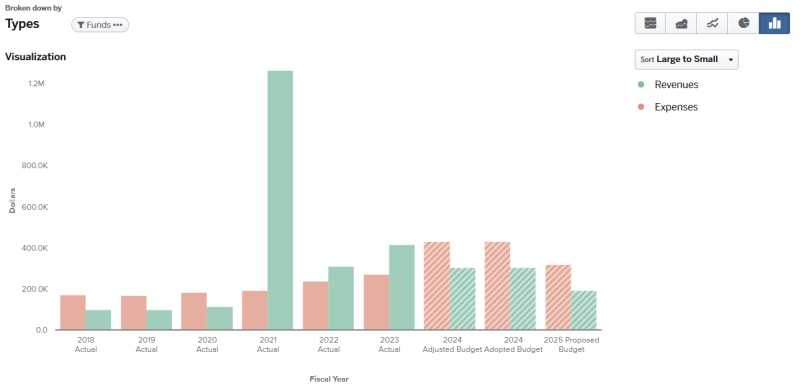
| Fiscal Year | Expenses | Revenues |
|---|---|---|
| 2018 Actual | $173,640 | $98,528 |
| 2019 Actual | $169,094 | $101,133 |
| 2020 Actual | $183,941 | $113,834 |
| 2021 Actual | $192,238 | $1,263,919 |
| 2022 Actual | $239,163 | $312,673 |
| 2023 Actual | $272,335 | $416,249 |
| 2024 Adjusted Budget | $431,801 | $305,384 |
| 2024 Adopted Budget | $431,801 | $305,384 |
| 2025 Proposed Budget | $319,799 | $193,276 |
Mesa County Lower Valley PID
The Mesa County Lower Valley PID was established by resolution of the Board of County Commissioners in 2004 in order to fund sanitary sewer services for residents of Mack. The district pays the County to administer the sewer system.
Charges for sewer service are the district’s only regular source of revenue. In 2022-2024, the district will also receive state funding and County support for major capital improvements.
Budget
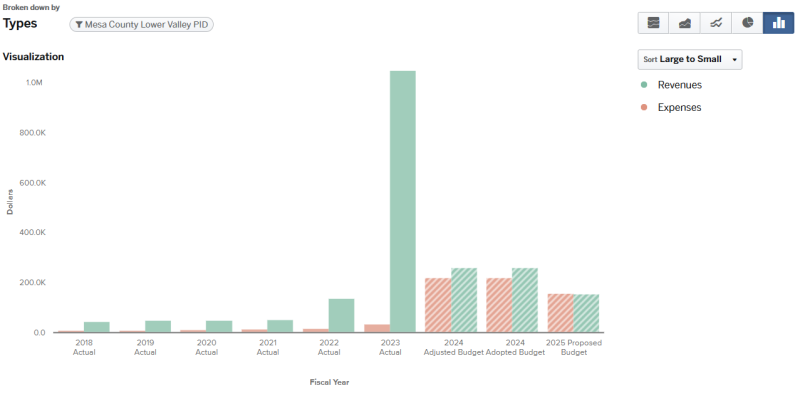
| Fiscal Year | Expenses | Revenues |
|---|---|---|
| 2018 Actual | $9,974 | $46,164 |
| 2019 Actual | $10,413 | $50,355 |
| 2020 Actual | $11,310 | $49,607 |
| 2021 Actual | $13,954 | $52,343 |
| 2022 Actual | $17,039 | $138,792 |
| 2023 Actual | $34,400 | $1,047,663 |
| 2024 Adjusted Budget | $220,383 | $261,416 |
| 2024 Adopted Budget | $220,383 | $261,416 |
| 2025 Proposed Budget | $158,265 | $155,723 |
Mesa County Whitewater PID
The Mesa County Whitewater PID was established by voter approval in 2006 in order to fund the operation and maintenance of the Whitewater sewer system. The district pays the County to administer its sewer system.
The district receives revenue from charges for sewer services and is supplemented by transfers from Mesa County’s General Fund. The district is exempt from TABOR spending and revenue limits.
Budget
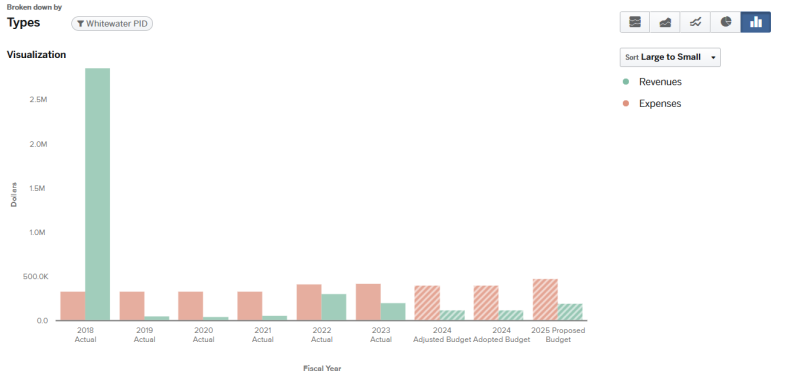
| Fiscal Year | Expenses | Revenues |
|---|---|---|
| 2018 Actual | $333,080 | $2,858,165 |
| 2019 Actual | $332,050 | $51,688 |
| 2020 Actual | $331,632 | $46,482 |
| 2021 Actual | $333,399 | $63,789 |
| 2022 Actual | $419,299 | $310,202 |
| 2023 Actual | $426,404 | $205,059 |
| 2024 Adjusted Budget | $405,272 | $122,095 |
| 2024 Adopted Budget | $405,272 | $122,095 |
| 2025 Proposed Budget | $481,865 | $198,646 |