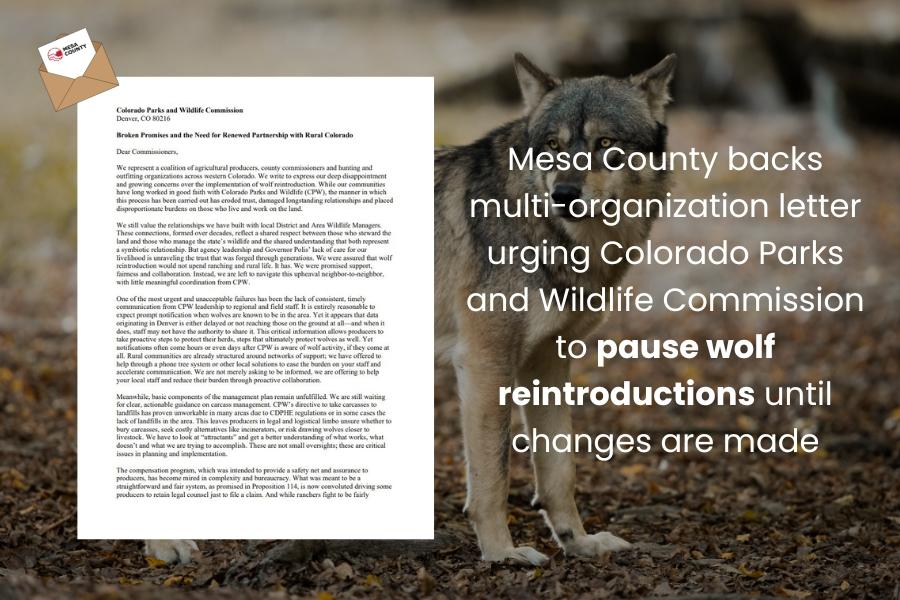
Mesa County backs multi-organization letter urging Colorado Parks and Wildlife Commission to pause wolf reintroductions until changes are made
The Board of Mesa County Commissioners ratified a letter at their June 24 public hearing that Mesa County, along with several other western Colorado counties and members of coalitions and associations, submitted to the Colorado Parks and Wildlife Commission regarding continued concerns about the way the gray wolf reintroduction has been implemented.
The letter states, “We strongly urge the Commission to pause future wolf reintroductions until the core programs - communication, carcass disposal, depredation investigations and compensation are fully implemented, functional and demonstrably effective. It is unreasonable and irresponsible to continue adding wolves to the landscape when foundational components of the management plan are not in place and are failing the people they are supposed to support.”
The letter focuses on broken promises made in the gray wolf reintroduction process and the need for renewed partnership with rural Colorado.
“Here we are today, really working and advocating for what Mesa County residents and rural Colorado not only wants, but needs,” said Commissioner Bobbie Daniel.
The full letter is below:
We represent a coalition of agricultural producers, county commissioners and hunting and outfitting organizations across western Colorado. We write to express our deep disappointment and growing concerns over the implementation of wolf reintroduction. While our communities have long worked in good faith with Colorado Parks and Wildlife (CPW), the manner in which this process has been carried out has eroded trust, damaged longstanding relationships and placed disproportionate burdens on those who live and work on the land.
We still value the relationships we have built with local District and Area Wildlife Managers. These connections, formed over decades, reflect a shared respect between those who steward the land and those who manage the state’s wildlife and the shared understanding that both represent a symbiotic relationship. But agency leadership and Governor Polis’ lack of care for our livelihood is unraveling the trust that was forged through generations. We were assured that wolf reintroduction would not upend ranching and rural life. It has. We were promised support, fairness and collaboration. Instead, we are left to navigate this upheaval neighbor-to-neighbor, with little meaningful coordination from CPW.
One of the most urgent and unacceptable failures has been the lack of consistent, timely communication from CPW leadership to regional and field staff. It is entirely reasonable to expect prompt notification when wolves are known to be in the area. Yet it appears that data originating in Denver is either delayed or not reaching those on the ground at all—and when it does, staff may not have the authority to share it. This critical information allows producers to take proactive steps to protect their herds, steps that ultimately protect wolves as well. Yet notifications often come hours or even days after CPW is aware of wolf activity, if they come at all. Rural communities are already structured around networks of support; we have offered to help through a phone tree system or other local solutions to ease the burden on your staff and accelerate communication. We are not merely asking to be informed, we are offering to help your local staff and reduce their burden through proactive collaboration.
Meanwhile, basic components of the management plan remain unfulfilled. We are still waiting for clear, actionable guidance on carcass management. CPW’s directive to take carcasses to landfills has proven unworkable in many areas due to CDPHE regulations or in some cases the lack of landfills in the area. This leaves producers in legal and logistical limbo unsure whether to bury carcasses, seek costly alternatives like incinerators, or risk drawing wolves closer to livestock. We have to look at “attractants” and get a better understanding of what works, what doesn’t and what we are trying to accomplish. These are not small oversights; these are critical issues in planning and implementation.
The compensation program, which was intended to provide a safety net and assurance to producers, has become mired in complexity and bureaucracy. What was meant to be a straightforward and fair system, as promised in Proposition 114, is now convoluted driving some producers to retain legal counsel just to file a claim. And while ranchers fight to be fairly compensated for real and measurable losses, we now face calls mostly from urban-based animal rights groups with no direct ties to working lands to dismantle the very compensation system voters were assured would accompany wolf reintroduction. That is unacceptable. Coloradans did not vote for wolf reintroduction in a vacuum; they voted for a comprehensive plan that includes meaningful support for those directly impacted.
Despite these challenges, producers have continued to care for the land, support wildlife habitat and protect their herds. Unfortunately, the concerns of our communities are increasingly dismissed or disregarded. This is not the model of partnership CPW once stood for. Communication is deteriorating. Guidance is missing. Compensation is delayed. And the growing perception is that rural Coloradans are no longer seen as partners, but as obstacles.
How did we get here? How did the reintroduction of one species become so politically charged that science, practicality and partnership have taken a back seat?
It is becoming increasingly clear that political agendas, not science, are driving critical decisions. We have long fought for this agency and its mission. With over 125 years of experience, wildlife management should be based on data, functionality and local expertise not public relations campaigns, media headlines or one administration’s desire to fundamentally change Colorado.
We strongly urge the Commission to pause future wolf reintroductions until the core programs - communication, carcass disposal, depredation investigations and compensation are fully implemented, functional and demonstrably effective. It is unreasonable and irresponsible to continue adding wolves to the landscape when foundational components of the management plan are not in place and are failing the people they are supposed to support.
Wolves are now part of Colorado’s landscape. But if we want the reintroduction to succeed, it cannot be at the expense of the very communities that help shape Colorado’s identity and protect its natural beauty. This is not just a policy failure it is a breach of public trust.
We call on the Commission to act swiftly to restore that trust. Recommit to true partnership with those on the ground. Listen to the voices of producers, county leaders and outfitters who are ready and willing to be part of a workable solution. We ask only to be treated as the partners we were promised we would be.