
Measles
Current U.S. outbreak information

There are 23 confirmed cases of measles in Colorado reported in 2026.
In 2025, there were 36 confirmed cases of measles in Colorado, including 11 cases in Mesa County.
Mesa County Public Health and the Colorado Department of Public Health and Environment continue to closely monitor the situation in Colorado and in other states.
Measles Frequently Asked Questions
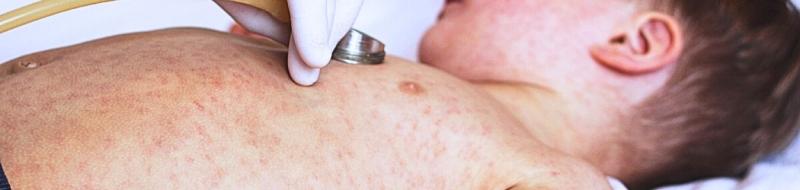
Symptoms of measles include high fever, cough, runny nose, watery eyes, and a red blotchy rash starting on the face and then spreading to the rest of the body.
- Symptoms begin to appear about 7 to 14 days after a person is infected, but it can be as long as 21 days.
- 2-3 days after symptoms begin, Koplik spots (tiny white dots) may appear inside the mouth.
- After 3-5 days, a red rash appears, beginning at the hairline and spreading down the rest of the body over the next few days. When the rash appears, a person’s fever may spike to more than 104˚F. Symptoms may last for one to two weeks.
Measles can be serious in all age groups. However, several groups are more likely to suffer from measles complications:
- Infants
- Pregnant women
- People with compromised immune systems, such as from leukemia or HIV infection
Serious complications from measles include:
- 1 out of 20 children who get measles get pneumonia which is the most common cause of death for children with measles.
- 1 in 5 unvaccinated people in the US who get measles are hospitalized.
- 1 out of every 10 children with measles will get ear infection.
- 1 in 1,000 children who get measles develop encephalitis, or swelling of the brain.
- Nearly 1-3 of every 1000 children who become infected with measles will die from respiratory and neurologic complications.
If you are pregnant and have not had the MMR vaccine, complications during pregnancy from measles infection could cause premature birth or low birth weight.
Measles is passed from person to person by airborne droplets from coughing and sneezing. Measles can also be spread by contact with nose and throat secretions from ill persons, or by touching a contaminated surface.
Infected people can spread the virus four days before their rash starts and through four days after the rash appears. The virus can also live up to two hours in the air after an infected person leaves an area.
If someone is diagnosed with measles, the health department will work with the individual to determine when it is safe to return to work or school. Usually people can can return to normal activities when they have had a rash for more than four days.
Measles can be prevented by the measles vaccine. It is usually given in combination with rubella and mumps vaccines, or the MMR vaccine. It is recommended for all children at 12 to 15 months of age and again at four to six years of age. If a person has not received a second dose of the vaccine between four and six years of age, it may be given at any age thereafter. The two doses of vaccine normally provide lifelong immunity.
While measles was declared eliminated in the US with the help of effective vaccines, it is still common in many parts of the world. Every year, measles is brought into the US by travelers who got measles in other countries. If you think you have symptoms of measles or were exposed to measles, please contact your health care provider or your county health department immediately.
Most people in the United States have a low risk of contracting measles due to an effective vaccine. Unvaccinated people can be exposed to measles when they travel abroad or in the U.S. where an outbreak is occurring.
If you believe you have measles, call your healthcare provider as soon as possible. Let them know of your symptoms and they will advise you on what to do next. It is important to call first because measles is highly contagious.
People are contagious about four days before their rash starts to four days after it appears. If you might have measles, stay home during this time.
A doctor or health care provider can test for measles with a throat or nasal swab.
Please call ahead to your provider if you think you might have measles. They can advise you on how to enter the building without exposing other patients and staff.
- If you were born before 1957, you do not need a vaccine because nearly everyone born during this period got the disease during childhood. An exception might be healthcare workers without proof of immunity.
- If you were immunized between 1963 and 1967, you might have received a vaccine that was less effective than the current vaccine. You may need an additional dose of the live MMR vaccine. If you aren’t sure, talk with your healthcare provider.
- Ways to check your Colorado vaccine records:
- People with weakened immune systems, those who have had an organ transplant, or those who are receiving certain medical treatments including chemotherapy, radiation, and immunotherapy.
- The vaccine is usually not given to children under 1 year of age although it may be given to children as young as 6 months if they are traveling internationally or live in an area where there is an outbreak.
Get more information from trusted sources
Helpful links
- Find a vaccine provider or visit your local pharmacy.
- Traveling Abroad? Check if You’re Protected Against Measles
Measles information for parents (PDF)
Information for medical providers
- Report this disease immediately at 970-254-4120 or on the CDPHE website.
- Health Care Provider Quick Sheet: What to do when you suspect a patient might have measles.
- Health Care Provider Reference Sheet: Measles Clinical and Epidemiological Overview.
- Health care provider FAQ.
- Health care settings FAQ: preparing your facility for measles.
- Infection control guidance for emergency medical services.
- How to test for measles at CDPHE.
- Recommendations for vaccination and assessing immunity.
- CDC: Adult MMR vaccination decision tree
- Measles update for health care professionals slides | Presentation recording (May 7, 2025)
- CDC: Infection Prevention and Control Recommendations for Measles in Healthcare Settings.